 Back to Blog
The Crazy Swede: Göran Kropp's Extraordinary Journey to Everest
Alpine Karakoram
The Crazy Swede: Göran Kropp's Extraordinary Journey from Sweden to Everest
Imagine cycling thousands of kilometres across continents, carrying your mountaineering equipment, and then climbing Mount Everest without supplementary oxygen. This was not a fictional adventure. It was the remarkable journey of Swedish mountaineer Göran Kropp, famously known as the Crazy Swede.
In October 1995, Göran Kropp left Sweden with an extraordinary ambition: to travel to Mount Everest using his own strength, climb the world's highest mountain, and return home by bicycle.
His journey crossed several countries, including Pakistan, before reaching the Himalayas. What followed became one of the most unusual and memorable expeditions in modern mountaineering history.
Who Was Göran Kropp?
Göran Kropp (1966–2002) was a Swedish mountaineer, adventurer and endurance cyclist. His fascination with mountains began during childhood. At just six years old, his father took him to climb Galdhøpiggen, Norway's highest mountain.
As he grew older, mountaineering became a central part of his life. He served in the Swedish Paratroopers and developed the physical endurance and discipline that would later support his climbing ambitions.
Before his famous Everest expedition, Kropp had already established himself as a serious high-altitude mountaineer. In 1993, he became the first Swede to summit K2 (8,611m), one of the most challenging mountains in the world.
However, his greatest adventure was still ahead.
The Crazy Idea: Cycling from Sweden to Everest
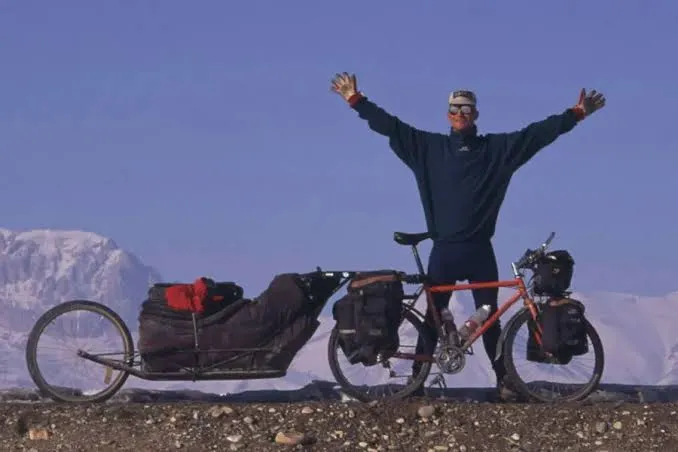
On 16 October 1995, Kropp departed Stockholm, Sweden, with a specially equipped bicycle and a one-wheeled trailer carrying his expedition supplies.
His objective was simple in concept but extraordinary in execution: cycle from home to Everest, climb the mountain, and return to Sweden by bicycle.
According to his own account published in the American Alpine Journal, his route passed through Germany, the Czech Republic, Slovakia, Hungary, Romania, Bulgaria, Turkey, Iran, Pakistan, India and Nepal.
Pakistan was an important part of this remarkable overland journey.
For Kropp, the expedition was not simply about reaching another summit. It was about making the entire journey under his own power, rather than flying to Nepal and joining a conventional commercial expedition.
Through Pakistan Towards the Himalayas
After travelling across Europe and entering Asia, Kropp continued east through Iran and Pakistan before reaching India and Nepal.
His journey through Pakistan formed part of the long cycling route connecting Europe with the Himalayan region.
For mountain enthusiasts, this is an especially interesting part of his story. Pakistan, home to some of the world's greatest mountain ranges, including the Karakoram and Himalayas, was one of the countries he crossed on his way to Everest.
After reaching Kathmandu, Kropp rested for approximately three weeks before continuing towards the mountain.
His journey was far from over. In fact, the most demanding part was about to begin.
From Bicycle to Backpack: The Journey to Everest Base Camp
Kropp cycled from Kathmandu towards Jiri, where the road ended and the walking approach to Everest began.
He then carried approximately 65 kilograms of equipment towards Namche Bazaar, completing the journey in 13 days.
He subsequently transported his climbing equipment to Everest Base Camp twice.
Think about the scale of this undertaking. After cycling across continents, he still had to carry his own high-altitude equipment through the Himalayan trekking routes.
His expedition was built around self-reliance, physical endurance and an unusual commitment to doing as much as possible under his own power.
The First Summit Attempt: Turning Back Near the Top
On 3 May 1996, Kropp made his first attempt to reach the summit of Everest.
He climbed to just below the South Summit but was exhausted and concerned about the time. He decided to turn back rather than continue into a potentially dangerous descent.
According to Guinness World Records, he had come within approximately 90 metres of his goal.
It was a difficult setback, but the expedition was not over.
The 1996 Everest disaster, during which eight climbers died in a severe storm, further delayed his plans. Kropp also helped transport medicines to climbers affected by the disaster.
He would have to wait for another opportunity.
23 May 1996: Reaching the Summit of Mount Everest
On 23 May 1996, Göran Kropp finally reached the summit of Mount Everest at 8,849 metres, without supplementary oxygen.
He was accompanied by Ang Rita Sherpa and Jesus Martinez during the successful summit push.
His achievement was extraordinary not simply because he climbed Everest without bottled oxygen, but because of the remarkable journey that had brought him there.
He had cycled from Sweden, crossed several countries, travelled through Pakistan, carried his own equipment towards Base Camp and eventually stood on top of the world's highest mountain.
His expedition became recognised by Guinness World Records for the longest-distance non-motorized sea-to-summit ascent of Everest without bottled oxygen.
The Journey Was Not Complete: Cycling Home
For many climbers, reaching Everest's summit marks the end of an expedition.
For Kropp, it was only part of the bigger journey.
After descending from the mountain, he planned his return to Sweden by bicycle. His original journey had always been about travelling from home to the summit and back using his own strength.
His own account in the American Alpine Journal records that he returned towards Sweden by bicycle via Russia, accompanied by his girlfriend.
The complete expedition covered approximately 17,000 kilometres and lasted one year and eight days, according to his 1997 account.
It was a journey that combined long-distance cycling, high-altitude mountaineering and an extraordinary level of personal commitment.
The Legacy of the Crazy Swede
Göran Kropp continued to pursue ambitious adventures after his Everest expedition. His approach to mountaineering was unconventional, combining physical endurance, independence and a deep interest in the journey itself.
On 30 September 2002, Kropp died in a rock-climbing accident in Washington State, USA, at the age of 35.
Although his life was cut short, his 1995–96 expedition remains an extraordinary chapter in mountaineering history.
He demonstrated that a mountain expedition can be much more than a climb. It can be an entire journey across countries, cultures and landscapes, driven by one remarkable ambition.
Göran Kropp, the Crazy Swede, did not simply travel to Everest. He made the journey itself part of mountaineering history.
Final Thoughts
The story of Göran Kropp reminds us that the greatest adventures are not always defined by the summit alone. Sometimes, the journey to the mountain is just as remarkable as standing on top of it.
From Sweden, through Pakistan, to the summit of Everest and back home, his expedition remains an inspiration for mountaineers, explorers and adventure enthusiasts around the world.
At Alpine Karakoram Adventure, we believe that every mountain has a story worth discovering, and every great expedition leaves something behind for future generations.
Explore the mountains. Discover their history. Follow the spirit of adventure.
Alpine Karakoram
At Alpine Karakoram, we are dedicated to providing the ultimate mountain experiences, bringing adventurous souls to the breathtaking peaks of the Karakoram.